What to see inside the Palais Garnier, in walking order
The Grand Staircase
White marble, a double sweep, and sightlines built for watching other people arrive. On performance nights I stood at the top of it for eleven seasons and can confirm the building’s open secret: the audience is the show, and Garnier designed accordingly. By day you can stand mid-flight as long as you like, which no opera-goer ever could.
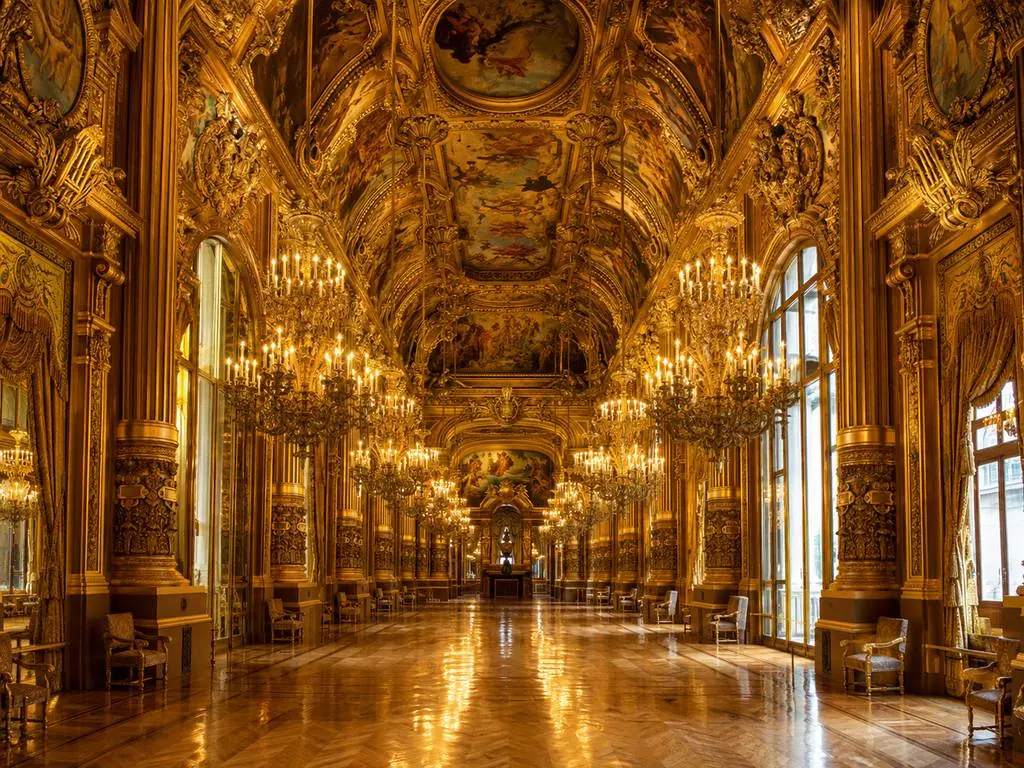
The Grand Foyer and the loggia
Up the stairs, the Grand Foyer runs gilded end to end, a room built so the interval could compete with the stage. Step onto the loggia for the view down the Avenue de l’Opéra. This is the room that makes people whisper, though nothing requires it of them.
The auditorium, if your day allows
A horseshoe of red velvet and gold, 1,979 seats, the bronze-and-crystal chandelier of about seven tonnes overhead, and above that Marc Chagall’s 1964 ceiling, installed over Jules-Eugène Lenepveu’s original rather than replacing it. Parisians still argue about the Chagall; I am on the unforgiving side of that argument, but look up and pick your own. Rehearsals close this room frequently and without notice — the Opéra says plainly that no ticket guarantees it, and the practicalities are on opening hours. Box 5 is here too, with its “ghost’s box” plaque — a modern wink at Leroux, whose real material is unpacked on the Phantom page.
The library-museum
The Bibliothèque-musée de l’Opéra sits inside the visit route: scores, set models and paintings from three centuries of the institution. Visitors in a hurry walk through it; visitors who slow down tend to name it their surprise of the building.
What you cannot see
The stage, the workshops and the rehearsal rooms are working spaces and stay closed to all visit tickets, including every tour on this site. The underground cistern — the famous “lake” — is closed too; what is actually down there is on the underground lake page. From the square outside, look up: gilded Apollo stands on the roofline between Poetry and Music.
If the auditorium is open when you arrive, go there first and save the foyer for afterwards. Rehearsal calls do not consult your route, and the gilding will still be there at the end.
Walking it with the stories attached
Self-guided, the rooms are beautiful and silent about themselves. The dramatized guided visit — €40, ninety minutes, entry included, 4.7 across 134 reviews — walks this same public route with the telling attached, in English or French slots. When to go for the quietest rooms is on best time to visit.
Frequently asked questions
What are the must-sees inside the Palais Garnier?
The marble double staircase, the gilded Grand Foyer with its loggia, the auditorium when rehearsals allow, and the library-museum on the visit route. In that order it fits an unhurried ninety minutes — how long it takes.
Can you see the auditorium on a visit?
Often, not always. Rehearsals close it frequently and without notice, and the Opéra warns that no ticket guarantees access — the full truth lives on opening hours and closures.
Is Box 5 from the Phantom real?
The box is real and sits in the auditorium; the “ghost’s box” plaque is a modern wink, not evidence of a tenant. The 1896 accident that fed the novel is on the Phantom page.
Can visitors see the underground lake?
No. It is a sealed masonry cistern under the building, not a lake, and it is closed to all visitors — Paris firefighters use it for dive training. The debunk is on the underground lake page.