The Palais Garnier, explained
The Palais Garnier is the 1875 Paris opera house — a working theatre you can visit by day, if you book online first. Visits are never sold at the door, and rehearsals can close the auditorium without notice. Here is the whole picture, from someone who worked inside it.
The Palais Garnier is the opera house Charles Garnier built for Paris between 1861 and 1875 — a 1,979-seat horseshoe of red velvet and gold beneath a bronze-and-crystal chandelier of about seven tonnes — and it sells visit tickets online only, never at the door.
I am Céline Marchand. For eleven seasons I worked this house as an ouvreuse — an usher — before moving to daytime visits work, and I live in the 9th, close enough that I pass Garnier’s façade most days. I have watched a great many visitors arrive with the wrong assumptions. This page exists to remove them before they cost you a morning.
Two truths before you buy anything
First: there is no box office for visits. The Opéra’s rule is printed on its own site — “Online booking mandatory. No tickets for visits are sold on site” — yet most mornings someone waits at the Rue Scribe corner for a window that will not open (why you cannot just walk in). Second: no ticket guarantees the auditorium. This is a working theatre, rehearsals close the room frequently and without notice, and the Opéra warns you of exactly that. Buy your ticket knowing the staircase and the foyer are certain and the red-and-gold room is a hope (hours and closures).
What the building actually is
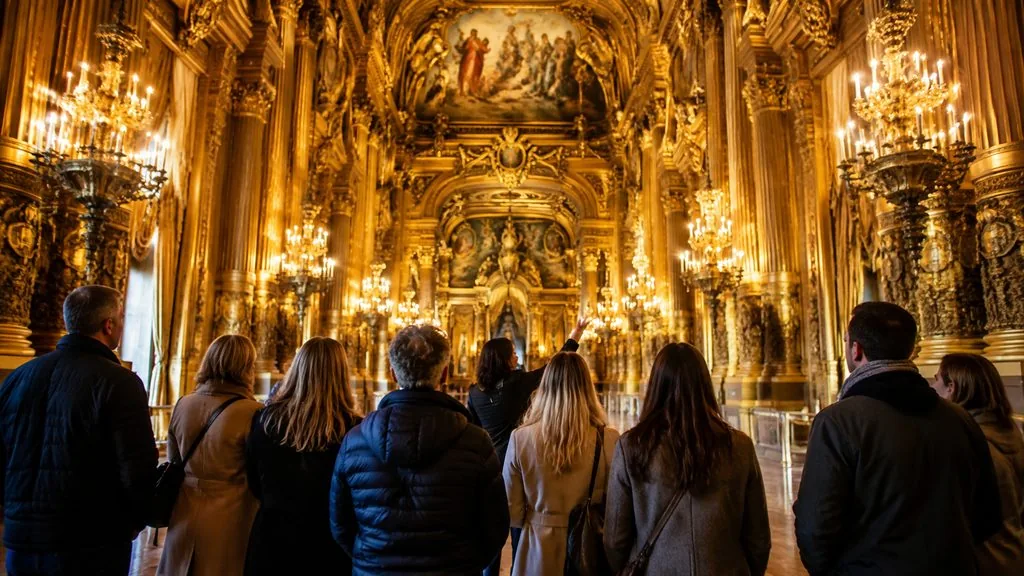
Napoleon III commissioned it as part of Haussmann’s remaking of Paris, and the 1861 competition was won by Charles Garnier, a 35-year-old almost nobody had heard of. The build took fourteen years. Groundwater flooded the foundations, then the Franco-Prussian War, the fall of the Second Empire and the Commune each stopped the work, and for a stretch the unfinished building served as a military depot and hospital. It opened on 5 January 1875 (the fourteen years, in full). Inside, two rooms do the remembering for everyone: the white marble double staircase and the gilded Grand Foyer. The auditorium seats 1,979 under the chandelier, and around it is Marc Chagall’s 1964 ceiling, installed over — not in place of — Lenepveu’s original. Parisians still argue about it. I have not forgiven it myself, though I understand the people who love the colour it throws at all that gold.
The Phantom is built on true things
On 20 May 1896, during a performance of the opera Hellé, one of the chandelier’s counterweights broke loose and fell through the ceiling into the audience, killing one person and injuring others. The full chandelier has never fallen. Gaston Leroux folded that accident, the water under the building and Box 5 into The Phantom of the Opera, serialised in 1909–10 (the real story). The famous lake is real and is not a lake: Garnier’s answer to the flooding was a sealed masonry cistern that counteracts the water pressure and steadies the building. No shores, no gondolas; Paris firefighters use it for dive training (the cistern, explained). Box 5 exists, and the ghost’s plaque on it is a modern wink, not evidence.
The official ticket, or a tour
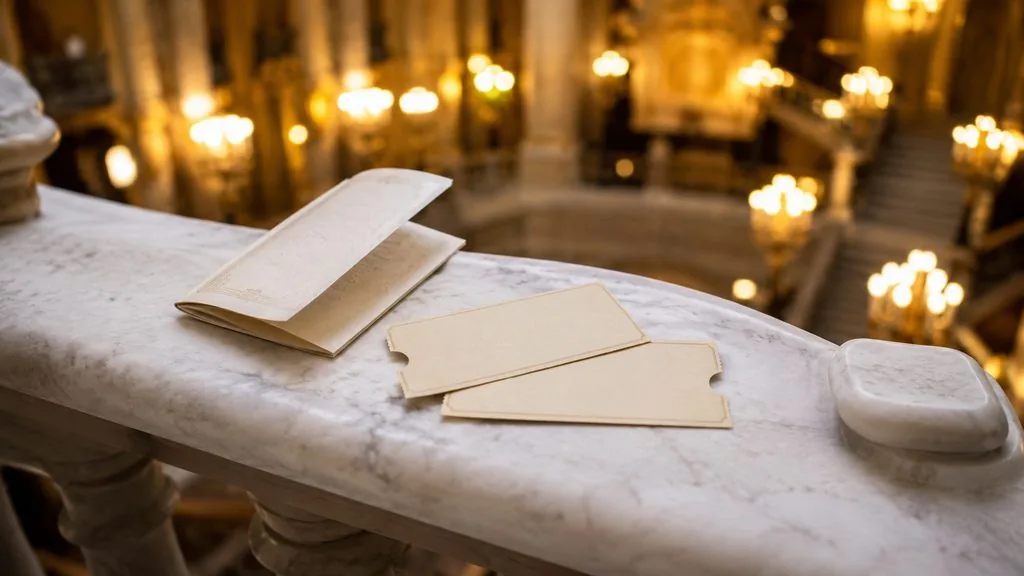
The official self-guided ticket at operadeparis.fr is the cheap way to see the building, and if all you want is the rooms, buy it and spend the difference at the Café de la Paix across the square (what a visit costs). What a tour adds is a storyteller, because the rooms are spectacular and largely unexplained. The dramatized visit is the one I point people to first: ninety minutes with a costumed guide, entry included, in separate French and English slots, and it carries more reviews than everything else in this catalogue put together (my full review, all the guided options). One warning: the theatre-district walking tour is an evening of Phantom and Les Misérables lore around the building, and it never goes inside. The catalogue for this monument is young, most listings have thin review pools, and I flag it every time, because your trust is the only thing this site has.
What I tell people at the door
Come at 10:00 on a weekday, when the doors open and the groups have not landed, and give the visit an hour to an hour and a half (the quiet hours). Take the métro: Opéra, on lines 3, 7 and 8, puts you on the square, RER A at Auber is the closest regional stop, and the visitor entrance is the Rue Scribe–Rue Auber corner, not the grand steps everyone photographs (arriving at the right door). Jeans are fine for a daytime visit, and even for performances smart-casual is a norm rather than a rule (the dress question). Leave the suitcase at the hotel: luggage is on the prohibited list and there is no big-bag storage (what you cannot bring). The house closes on 1 January and 1 May and on exceptional days besides, so check the official calendar before you build a morning around it.
That is the whole method. Sort yourself first: rooms only, the official ticket; stories, the dramatized visit. Either way, book online before you come — and if the auditorium doors happen to stand open when you reach them, go in first and look up before the room fills.
Ready to book?
Check dates for the dramatized visit below, or start from the full list of tickets and tours.
Frequently asked questions
Do I need to book Palais Garnier tickets in advance?
Yes. The Opéra sells visit tickets online only — none at the door. The walk-in page explains what happens if you turn up unbooked.
Is the auditorium always open during visits?
No. Rehearsals close it frequently and without notice; no ticket guarantees it. The hours page covers how to improve your odds.
Is a guided tour worth it over the basic ticket?
For the building alone, the official self-guided ticket does the job. A guide earns the difference with the stories — see guided tours compared.